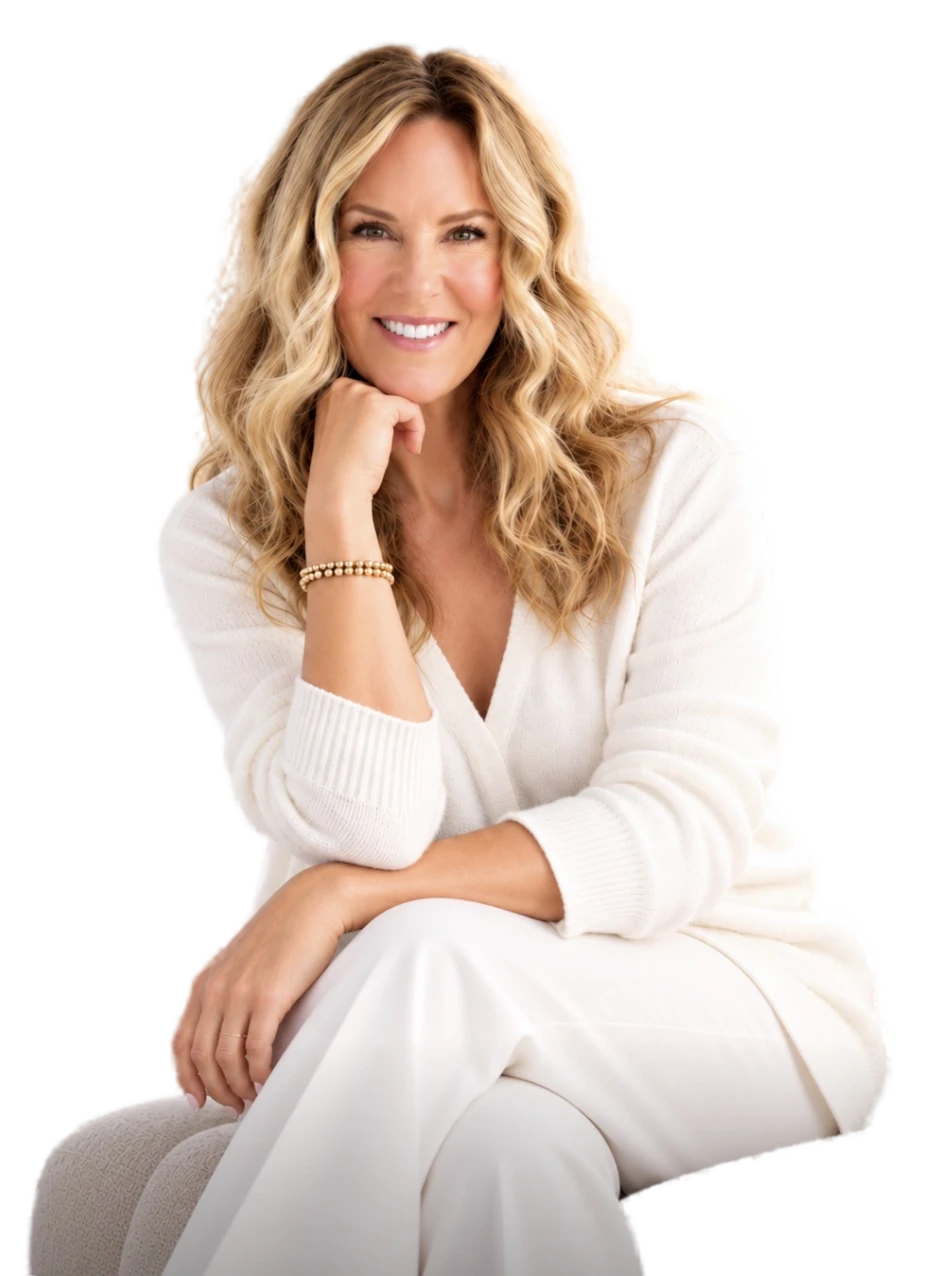
 Lynne Goldberg Meditation

On Living Ageless and Bold, Lynne talks about meditation, sleep challenges around menopause, and finding purpose and new choices in midlife.
Highlights
- “You're training yourself to come back to the present moment right here, right now.”
- “Better to do five minutes and do it than say, ah, I don't have the time.”
- “You're not going unconscious, you're becoming more conscious.”
Transcript
[Christina introduces Lynne and asks how meditation and sleep became her work.]
Lynne Goldberg: I got into meditation when my life fell apart and it was like Chardonnay wasn't working. It was my 3 a.m. wake-up call and it was not keeping me asleep. And my mom had been diagnosed with terminal cancer. She was 54 when she passed. I had lost twin girls. I had lost my job. My marriage had just fallen apart. And I was like, I need something that can help me in this turbulent time that isn't Chardonnay, which was my drug of choice.
[Christina asks how Lynne found the strength to move forward after so much loss.]
Lynne Goldberg: I think that I was exceptionally lucky in that I recognized that what was happening, I saw it around me. So I was able to recognize that universality, like everybody goes through shit, everybody. And if we don't take it personally and we can start to recognize that, oh yeah, these are some role models that I have. And these are people that I've seen that have come through this, and let's see what they did that worked for them. And let's see if I can utilize some of those tools. And for me, that was really helpful.
[Christina asks who Lynne's role models were.]
Lynne Goldberg: My biggest one was Oprah.
[Christina agrees that Oprah helped many people through difficult times.]
Lynne Goldberg: I just thought she had such an incredible resilience to her and this ability to take the onus off of herself and recognize how she could be of service to so many others. And so that was really the thing that drove me. Okay, let me find the silver lining in this. Let me see what I can do and how I can help other people.
[Christina asks how Lynne first found meditation.]
Lynne Goldberg: I found meditation because my mom's doctor actually said that she should try it. And I thought, well, if it can work for her, I'll try that too. And this was many years ago, like close to 30 years ago. Meditation was not a thing. People were like, oh, you can be on some mountaintop or you could be eating granola in the corner. But if you're teaching meditation, it was odd. It was very, very odd.
[Christina recalls the stereotypes associated with meditation at the time.]
Lynne Goldberg: Very woo-woo. I was not a Birkenstock girl. I was definitely a Manolo kind of gal. And that was sort of that interesting dichotomy that I found to be really helpful for me, is that it didn't have to be one way of life. It could be a part, it could be a tool, it could be something that I found to be useful, but it didn't have to be my whole identity. And that was really a huge help for me in finding things that did work. And then once I discovered how useful it was, I was like, ah, I gotta help other people with this too.
[Christina describes her anxiety and asks for a simple daily meditation practice.]
Lynne Goldberg: So one of the greatest things that I find is that most of us don't have 30 minutes to sit down and meditate, or 20 minutes, or whatever it is. And every single time you get a notification on your phone or on your computer or anything, it's an opportunity to just pause and take a breath. And if you just do it, it becomes sort of habitual for yourself. And you probably get hundreds of them all day long. So it becomes your constant meditation, which is all meditation actually is, is building your attention muscle. You're training yourself to come back to the present moment right here, right now. A hundred times a day, however many times a day you do it.
Lynne Goldberg: And one of the things that we tend to do is we think, and we do, right? When we're meditating and you have to sit there, you're watching your thoughts and you're just observing, oh yeah, there's my mind getting carried off by a thought, and you come back to your breath, which is the object of your attention. Well, you can make anything the object of your attention. So if you're making it your phone notification, then every time that notification goes off, you can just say, okay, let me take a breath right now, and just make sure it's a conscious breath. So what I would say is the notification goes off. You breathe in for a count of four. You hold it for a count of four and you exhale for a count of six.
[Christina asks whether that short exercise counts as meditation.]
Lynne Goldberg: That is a tiny micro meditation.
[Christina compares this with her previous idea of sitting still for a long meditation.]
Lynne Goldberg: There's a lot of different ways you can meditate. Some people have walking meditations. It's always about bringing yourself into this moment awareness. That's all. Present moment awareness. Without judgment, moment to moment. So that's what you're training yourself to be able to do. What's great about a longer meditation is it's like going to the gym. If you only go once in a while, you're only going to get once in a while results. If you do it longer, you're going to start to improve that attention muscle. So the dosage doesn't have to be 30 minutes if you don't have 30 minutes. Better to do five minutes and do it than say, ah, I don't have the time.
[Christina asks how to practice meditation during her daily walks.]
Lynne Goldberg: So you want to be present with your senses. So you can notice what you're seeing, notice what you're smelling. Notice what you're feeling, so maybe it's cool air or maybe it's hot air, depending on where you live and what kind of temperature it is outside. You can feel the other sensations, maybe the clothes on your skin. You can notice the taste in your mouth. And you're just paying attention on purpose to everything that's happening around you.
Lynne Goldberg: And it's that ability to catch yourself because what do we do? We spend so much of our time on autopilot, right? Your mind is either racing ahead to the future or it's way back in what you should have done yesterday. Oh God, I shoulda, coulda, woulda, but instead of actually being present with what's happening right now. So right now you and I are talking. I'm sure you're not, but lots of people go ahead to, what am I going to say next? And how am I going to react then? And they're already 10 steps ahead instead of being right here, right now. So walking is just the same thing.
[Christina asks whether their conversation can also be a kind of meditation.]
Lynne Goldberg: Absolutely. And you can tell when someone's present. I hate being with somebody who's sitting there on their phone, looking down at their screen, and they're having a dialogue with you, but they're so not present for you. So I love this moment-to-moment conversation where you're alive and you're responding, and that's true presence. So I'm sure you're really good at presence, actually. If you do this regularly, you must be.
[Christina asks what meditation does inside the body.]
Lynne Goldberg: So much of what's happening for us is survival mode. So we're always trying to gauge for safety. Am I safe? Is everything okay? Is anything wrong? We have a negativity bias. And the negativity bias is so that we scan our environment to see if everything around us is okay. And it was really useful when we were walking through the savannah and there might be some tiger that might jump out at us at any moment. But in today's day and age, most of what we consider to be not safe are just things like that notification. If you are training yourself to be alarmed by it, oh no, there's bad news, it's coming in, and then your heart starts palpitating. Or maybe I'm waiting for something to happen, and there's that sense of anticipation that causes your heart to pound.
Lynne Goldberg: So what happens to your body in every single one of those events is you are reacting as if you're on the savannah and something bad is happening. So you have this feeling of something bad, and then you react as if something bad actually is happening. And what happens to our bodies is you have a release of cortisol, adrenaline, all those stress hormones that do not do your body good. And you end up having an increased heart rate. When you release adrenaline, cortisol, your heart rate goes up. You basically release sugar, so it's like a precursor to diabetes. Your immune system becomes diminished. So every time you're under constant chronic stress, you're lowering your body's immune system.
Lynne Goldberg: When you're meditating, it's the absolute opposite. You're releasing serotonin, which is a feel-good hormone. You're releasing oxytocin, which is the love hormone. And all of these things lead you to a more calm, relaxed state. It's not rocket science. It's that couple of breaths, and it's really a life changer.
[Christina asks what Lynne's own daily meditation practice looks like.]
Lynne Goldberg: I've done this for a lot of years. I really like it. I don't want to tell you what I do because I'm going to just discourage people. I didn't start like me. I started at 3 a.m. when I woke up. Today it's a little different. Today I recognize that if I don't get in my morning meditation or my evening meditation, I'm not as effective and as productive as I could be. I might have missed some things. Very often when I sit down for my meditation in the evening, it's like a bookend to my day. And I notice things that I might not have noticed. Things come up, I go back to the breath. But when they do come up, I'm like, oh yeah. And then I have an opportunity to address it from a much more calm, relaxed state as opposed to in that frenetic reactive mode. So I'm not answering your question on purpose.
[Christina describes waking at night with racing thoughts and asks what can help.]
Lynne Goldberg: Well, there's two things that are going on, and I'm saying this because the title of your show is over 50. So for any of us who have gone through menopause or who might be having dips in our estrogen levels, that can also affect your sleep patterns. So first thing I would say is check your hormones. That's a basic thing. See what's going on, because that's going to affect sleep. And then, if everything else is okay, and your cortisol levels aren't spiking at 3 a.m., which happens, then you can address it with just a relaxation exercise. And so we have lots and lots of those on the app.
Lynne Goldberg: I wouldn't say that meditating is the best thing to do because when you start to meditate at 3 a.m., then you end up training yourself that meditation equals sleep, and actually it's the opposite and we don't want that. You're actually trying to pay attention on purpose. You're not trying to fall asleep. You're not going unconscious, you're becoming more conscious. So really it's more about relaxation exercises that can look anything from hypnosis. We have hypnosis on the app. We have sleep meditations, which are basically guided visualizations that can help you relax. And those are very different.
[Christina asks whether counting sheep is a similar visualization technique.]
Lynne Goldberg: Well, what you're doing is the same thing. It's a meditation. You're paying attention to that. And when you notice that your brain is going on to, oh no, what am I going to do tomorrow? Did I put my schoolbooks in my bag? Then you are coming back to your sheep because you lose track. So it's really the same technique. So many different traditions have so many different versions of this. It's fabulous because you look at almost every single Eastern or Western tradition, you could have anything from mala beads, counting beads to counting sheep, to saying Om Mani Padme Hum, which is like a Buddhist recitation, or the Lord's Prayer. Every single one of these are examples of how we pay attention on purpose.
[Christina asks how Lynne came to co-found Breethe.]
Lynne Goldberg: So I really recognized for myself how useful meditation was, and I wanted my kids to learn. And they wouldn't listen to me. So I thought, if I can't get them to hear me, maybe they'll listen to their teachers. So I went to the schools and I started asking the teachers if they could help my kids learn. And of course the teachers were awesome and they said yes. And then they asked me to come teach them. So I started training teachers and they kept asking me to leave materials behind. But I didn't have any. So I was looking for a way that I could do these tapes. And then someone said, well, you could just make an app. I was like, oh wow, genius. Who knew? What a great idea.
Lynne Goldberg: I said, I'm not great at technology. I laughed so hard because technology is one of the greatest tools. It's incredible. But I definitely am a technophobe. I constantly am trying to teach myself how not to be scared of all the stuff that happens, all the bells and whistles. So an app was a real undertaking. It was really like, okay, put yourself into something that is completely out of your comfort zone. But it's turned out to be so incredibly useful and so helpful to so many people. And I'm just so grateful that we can use technology sometimes so well. It becomes such a useful tool.
[Christina notes Breethe's downloads and reviews and asks what the app offers.]
Lynne Goldberg: So there's a whole sleep section, which is awesome. That's for most of us, especially anyone who is menopausal or has gone through menopause or is perimenopausal, because we all know what that feels like. There's actually stuff for my body's aging and it sucks. There's a whole new way to reference or to relate to yourself and how you see yourself, and this idea of inside beautiful, outside beautiful.
Lynne Goldberg: Meditation is about the relaxation portion of it, but really there's also all the other stuff that comes with it, which is this idea of relating to all the different parts of our lives and midlife. And I'm writing a whole book on this actually right now, this idea of midlife being this opportunity to really notice what we've been doing up until we get to a certain age. And then we get to that certain age and we're like, oh no, this hasn't worked for me. Maybe it's your divorce or your job that you thought was going to be your forever job, and it ends up not being the career that you imagined yourself when you were starting out. Maybe it's a problem with your kids or whatever happens along the way that we hit those bumps in the road. And then how do you readjust? So we help with a lot of that.
Lynne Goldberg: That's my passion, actually, is helping people understand what patterns they've had in their past that they don't have to bring into their future.
[Christina describes her husband's cancer diagnosis and the decision to spend this stage of life on what matters.]
Lynne Goldberg: I had two cancer diagnoses from 55 to 60. I think like you just described, it could either be this feeling of foreboding gloom or it could be this awareness that time is finite, and how are you going to make it count? And I think we all know that, but I think it's one of the beautiful things that can happen with a diagnosis, that you really have to decide what it is that you value. And it makes you take stock of, and as you said so clearly, having purpose is valuable to your team and your family. And I think that's the gift that we have at this age, is that we get to decide what we want to do with our remaining chapters.
[Christina reflects on the value of time and the joy of having adult children.]
Lynne Goldberg: I love that too. I agree with you. But I love that quote because the idea of time being a precious commodity, I wrote about this in the book as well, this idea that we have money. It's a reflection of our value system. For some of us, it means safety. For some of us, it means freedom. For some of us, it's this idea of not being able to buy time. But what you're really saying is that none of that is the underlying core value, which is purpose, which is how are you going to make your life meaningful? And identifying that is all the difference. It's the difference between having a happy, meaningful, fulfilled life or feeling like there's that empty feeling inside, like you described before.
Lynne Goldberg: So I think most of us walk around having that empty feeling inside. And if you can find that spark, that authentic piece of you that helps you decide what it is that gives your life purpose and meaning, you've made it. That's the ultimate success story, isn't it?
[Christina describes the purpose she finds in the podcast and in helping listeners.]
Lynne Goldberg: One is about that feeling of interacting with people, which you described so beautifully, because I think that sense of connection is ultimately what gives our life value. You have these almost intimate conversations with people that you get to have numerous times, I would imagine. And how special is that? And then also the purpose and meaning. So I think in your case, it's like double folds. You get to do it in so many different ways. And in my case, I think there's this idea that there's a lot of people that we're reaching and helping.
Lynne Goldberg: And then there's also the feeling that I have of identifying things that are just difficult for people and making them normal. This whole mystery that somehow we're supposed to be okay with some of this stuff. Let's face it, getting a cancer diagnosis is scary, and losing your job or not knowing if you're gonna have enough money to retire or whatever things might have happened is hard. And so then what are some of the tools that can help you navigate those really challenging transitions? Because we all have them.
[Christina asks whether those tools are in the app or part of Lynne's individual work.]
Lynne Goldberg: So we have a lot in the app, and then I do a lot of one-on-one, but I'm also writing this book so that I can help reach more people.
[Christina asks when the book will be out.]
Lynne Goldberg: It'll be out next year, so we have something to look forward to.
[Christina asks whether Lynne has a title to share.]
Lynne Goldberg: I don't want to say yet. Because it might change, and I don't want to say anything that might not be the final title.
[Christina asks where a beginner should start in the app.]
Lynne Goldberg: My favorite starting place is we have this thing called the seven-day challenge. It basically walks you through seven days of meditating. And then if you like it, you can go on to the next week and the next week. And it's a 12-week program altogether. By the end of those 12 weeks, you've learned every single skill that you need that we've talked about today. So it's 12 weeks and it's 20 minutes a day. If you want something less than that, we have something that's five minutes a day. And again, it's dose. So if you have five minutes, do it. And then of course we have every single meditation from standing in line to I can't sleep to my body's changing and it sucks to my boss is a jerk, you name it.
[Christina confirms that listeners can find Breethe in the app stores and in the show notes.]
Lynne Goldberg: And if you want to reach me, you can find me at LynneGoldbergMeditation.com.
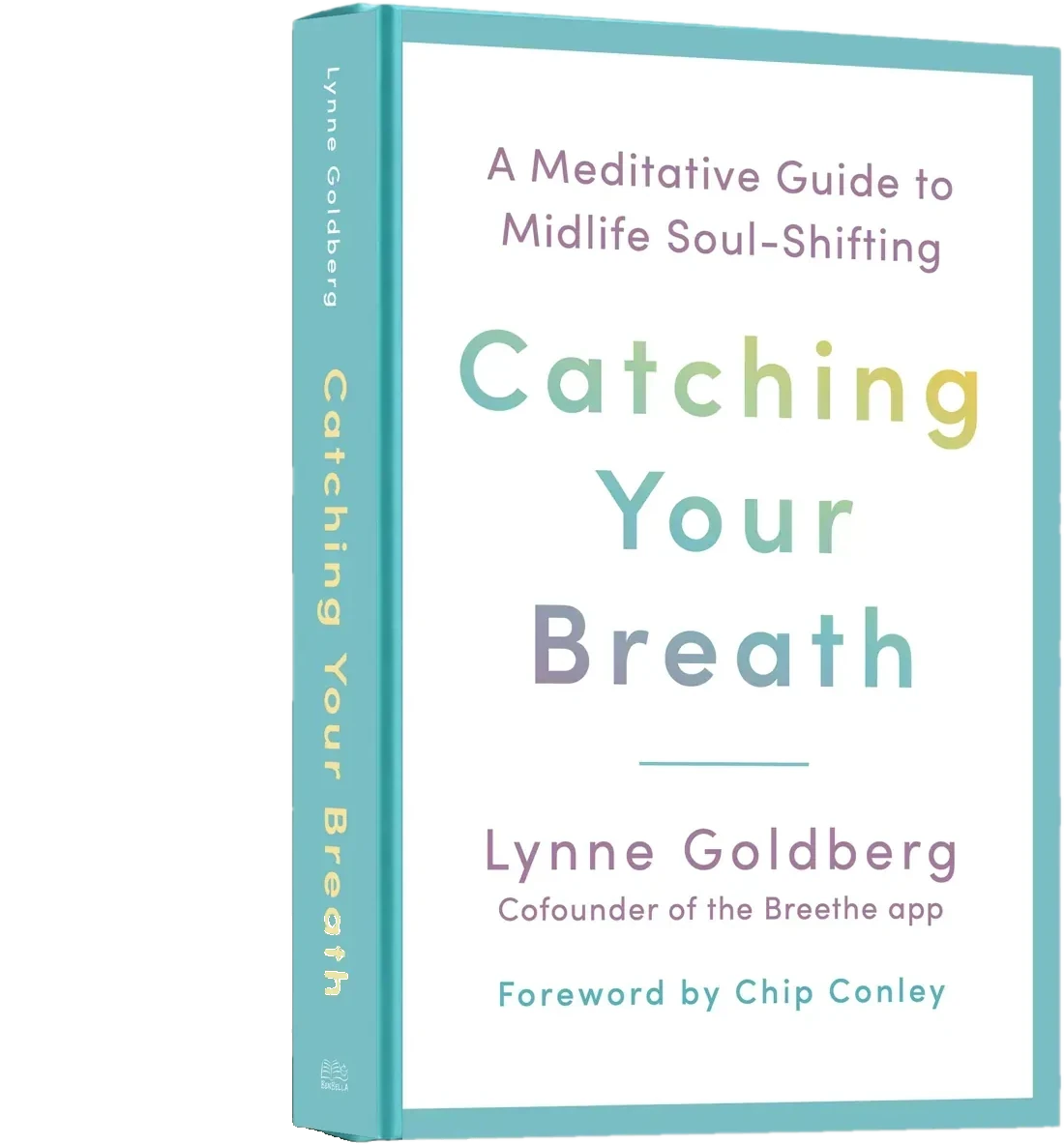
The book
Catching Your Breath
Lynne's new book, on meditation, choicefulness and the changes life brings.