 Lynne Goldberg Meditation

Listen on Journey Beyond Divorce Podcast
On the Journey Beyond Divorce Podcast, Lynne talks with Karen McMahon about how meditation helped her through divorce: seeing she's bigger than her old labels, watching the breath, pausing before reacting, and talking to herself with kindness.
Highlights
- “Meditation has been my life jacket in this crazy, crazy storm.”
- “What meditation helps us do is, rather than have that knee-jerk reaction, you have the opportunity to pause and respond rather than react.”
- “The me that doesn't get shaken by the storm is always there, and I can rely on that person.”
Transcript
[The host, Karen McMahon, introduces the episode on finding peace and calm in the middle of a divorce, and asks Lynne how meditation can support people who are healing and moving forward.]
Lynne Goldberg: So I think one of the things that we learn when we start meditating is that all those identities that we've had that have been so instrumental in how we consider ourselves, like a wife or a mom or whatever business you happen to be running. And particularly when divorce happens, all of a sudden that identity sort of goes poof and it's like, what the hell, and who am I?
Lynne Goldberg: And in fact, when we meditate, we learn that we're way, way bigger than that simple identity. And the serenity that comes from that sense of not being tied to that one tiny little micro piece of who you are allows for you to find a huge amount of freedom and a huge amount of peace. And it sounds very esoteric, but it's way simpler than that. It's just basically recognizing I'm not the thoughts that I'm thinking. There's that sense of why me, how come this is happening to me, that victimhood that happens to all of us when we see ourselves as the small I. But there's a very different way of having a relationship to all those events that we learn when we meditate.
[The host asks how Lynne would describe that bigger self to someone who has never done this kind of work.]
Lynne Goldberg: So if I were to ask you who you are, what would you answer me?
[The host answers with her labels and roles, and says she's much more than that.]
Lynne Goldberg: Right. And I think when we recognize all the labels, my teachers used to call it the positions and the possessions that we have. So you're not your position and you're not your possessions. And so once you recognize, oh, OK, well, if I'm not Lynne Goldberg, meditation teacher, then who am I? I just was separated a year and a half ago, and so clearly I'm not my ex's name either. And my kids all went off and I'm an empty nester. So now I'm not a stay-at-home mom. So who am I? Well, obviously those positions and possessions come and go, but who you are, deep, deep, deep down, when you access that greater self or whatever you want to describe it as, is bigger than that.
Lynne Goldberg: If I've only been thinking of myself as a wife and a mom, then I'm going to be very stuck in a rigid corner. But now all of a sudden there's this freedom to explore all of the other stuff that's out there. And so it's not this little small self, it's a much, much greater sense of possibility, of infinite, infinite choice. And that is something that we can access anytime we choose to.
Lynne Goldberg: In classic meditation terms, there's an ocean out there. Let's just call it a vast ocean. And Rumi said, I am not a drop in the ocean. I am the ocean in a drop. And if you see that you are part of an ocean, but you are also the ocean, then anything that's in that ocean, you can become.
[The host says many listeners feel broken, lost and scared after years of being belittled, and asks what the bridge is: the baby steps into meditation.]
Lynne Goldberg: So I think it starts with just watching your breath. Nothing more complicated than that. And when you watch your breath, you're observing, you're slightly detached, you're a witness to whatever it is that you're seeing. So if you're breathing and you notice that your breath is shallow, oh, interesting, my breath is shallow. If you notice that your breath is labored, oh, interesting, my breath is labored. You're not judging it. You're just simply watching whatever it is that you're doing.
Lynne Goldberg: Once you start to see that you are not the thoughts themselves that are going crazy in your mind, but you are the witness to those thoughts, then there's a sense of stepping back and you can observe what's happening all around you. I'm not in the movie, I'm watching the movie. And so once you're not in the drama, you can start to see the drama for what it is.
Lynne Goldberg: So you start by just showing up, watching the breath. You pay attention to the thoughts that happen. Oh, interesting, I'm belittling myself. Oh, interesting, I'm being hard on myself here. Oh, interesting, I'm feeling really anxious because such and such happened. And again, you're not belittling yourself for belittling yourself. You're just watching it. And it's that observation that helps you remove yourself, step back, observe, detach, and just watch what's happening. So that's the first little step.
[The host says that when her clients first sit, they judge themselves hard, and asks how Lynne encourages people away from the judge.]
Lynne Goldberg: You know, there's an old adage: whatever you practice gets stronger. So if you sit in meditation and all you practice is judgment, you're going to get really good at judging.
Lynne Goldberg: I'm going to tell an old story, and it's a very simple story, but it's one of my favorites. There's a story about an old man, and he's got this piece of land in his backyard, and one day 500 stallions show up in his backyard. And his neighbors come in and they're like, oh my God, you're so lucky, you're a rich man. And he looks at them and he goes, maybe good, maybe bad. And then the next day, his son is riding one of these wild horses. He falls off the horse and he breaks his leg, and the neighbors come back and they're like, oh boy, that's horrible, what a disaster. And he says, maybe good, maybe bad. And the next day the army comes to take all the 18-year-old men, and his son can't go because he has a broken leg. And they say, oh, you're so fortunate. Anyway, this goes on and on and on. And I think that's called life, right?
Lynne Goldberg: When I was getting divorced, it was the worst thing that could have possibly happened to me. Woe is me. Oh my God. And then, you know, maybe good, maybe bad. So I think it's that sense of not judging and just observing and recognizing that's just life. Life does this. I got cancer. It was the greatest thing that ever happened to me, truly, because it gave me an opportunity to see, wow, there are so many other ways I can show up here. There was such a sense of appreciation for how finite life is, and that real "what's important to me" aha moment that I got from getting a little wake-up call. Judgment is just a waste of time, frankly, because things change all the time.
[The host says our knee-jerk reaction to something that wasn't in our plan is to call it bad.]
Lynne Goldberg: And I think that's the ultimate control freak, right? Not my plan. But whose plan is it supposed to be? You're on a ride. Enjoy the ride. It's a roller coaster. And if you can just say, this is a lot more fun if I just say, OK, this is happening, what's next? As opposed to trying to drive a roller coaster. Ever see those little steering wheels on a roller coaster, and they're fixed? Imagine thinking that you have control over the roller coaster. It's the same thing with our lives.
[The host asks Lynne about her own story, since she was meditating long before her marriage ended, and how her toolbox helped her.]
Lynne Goldberg: So, you know, this is not my first rodeo. My life fell apart 20, maybe 30 years ago now. My mom was diagnosed with stage four colon cancer. She was 54 years old. I lost twin girls. I was fired from my career that I thought was the most important thing in my life, except for wanting to have these kids. And then my marriage fell apart. And that was my first tsunami.
Lynne Goldberg: And that's really where I started training in meditation. Originally, when my mom was first diagnosed, her doctor told her to try meditation, and I ended up becoming a meditation teacher. And this was way before meditation was, you know, no one was meditating. So, you know, maybe good, maybe bad. It was a wonderful, wonderful tool.
Lynne Goldberg: First marriage ends, the whole thing falls apart. Now I get remarried, kids, life is good. I started going into schools, and going into the schools one school at a time was a very ineffective way for me to teach meditation to the teachers. They asked me to leave behind materials, and so that's how I launched the app. Again, maybe good, maybe bad, right? So lots of different pathways led me to what ended up happening.
Lynne Goldberg: And then I now had these tools. These tools were extremely effective. And when this second tsunami hit, I actually thought, oh, this is why you practice. Isn't this so cool? Because I'm having a much easier time this time around. I have the tools to be able to weather this storm. I'm managing everything, to really enjoy my life and have a wonderful time and understand that the divorce is just a tiny, tiny little microcosm of who I am. The rest of me is way bigger than all of it.
[The host asks how decades of practice help when your buttons get pushed and the old, traumatized reactions fire.]
Lynne Goldberg: What meditation helps us do is, rather than have that knee-jerk reaction, you have the opportunity to pause and respond rather than react. And there's that microsecond of response that allows you to make a choice. How do I want to show up here? Do I want to show up with my "that's not fair" little girl voice, which I could easily do, by the way? I'm not saying that that little girl doesn't exist and isn't very present. But I also have the capacity, because I have a little bit of distance and the opportunity to respond, to be able to nurture that little kid and take care of her and see that, ouch, she's having a hard time.
Lynne Goldberg: And so that's our self-compassion practice. There are many, many different tools that help take care of that wounded, triggered kid and let you show up as the adult who needs to be there, with your fully functioning brain.
[The host says the first step in her own program is creating the pause, and asks whether meditation is practicing the pause.]
Lynne Goldberg: It's the pause. It's the breath. That's what it is. And that's very powerful.
[The host asks for a beginner's way in, since she encourages new clients to start with three to five minutes.]
Lynne Goldberg: So meditation is a muscle, basically. Practicing meditation is a muscle. And you wouldn't go out and play Chopin right away on the piano. You'd practice your scales.
Lynne Goldberg: It's hard to sit still when you're not used to sitting still. I mean, I am the poster child for that. When I started, I was the most type A, driven. I couldn't sit still for any amount of time. And anytime my mind went off into thought, I was galloping with it. And so now, when I help people, it's with a real sense of empathy, because I know how hard it is to sit. It is not an easy thing to do. And if you have this expectation of yourself that you're going to just get it, you're just going to disappoint yourself over and over again. It's going to be one more thing you're going to fail at.
Lynne Goldberg: So just see: I just have to start with my five minutes. That's it. I brush my teeth in the morning, I go to the bathroom, and I can sit for five minutes. And then five minutes becomes 10 minutes, and 10 minutes becomes 11. You wouldn't stop brushing your teeth and then go to the dentist and say, oh, I have a cavity, I'm going to quit this. You'd say, oh, it's something I have to do every single day. So over time you become skilled, and it becomes easier and easier to do.
Lynne Goldberg: So it's, again, that self-talk. How do you show up for yourself? Do you show up for yourself with impatience and expectation and judgment? Or do you show up with love and compassion and a sense of, I got you, baby. You can do this. You're doing something for yourself here. Because most of us who have come through a horrible divorce haven't been talked to like that in a long time.
Lynne Goldberg: So if you can show up for yourself like that, then you start training yourself in how you want to be talked to and how you can handle your own voices in your head. You're not that bad girl that can't get it right. You're that courageous fighter who's trying to do something good for herself because she wants something more. So that, to me, is the difference.
[The host asks whether it matters which kind of meditation you choose, and whether guided meditation is different from sitting with the breath.]
Lynne Goldberg: I often, often turn to a guided meditation when I just need help, something to lift my spirits or something that will be a blanket around me when I'm feeling crappy. I can't tell you how often I use guided meditations for that. So they all have different purposes.
Lynne Goldberg: And particularly if you're coming through a high-conflict divorce, one of the things that gets battered is your self-esteem and your sense of self. Just developing that love towards yourself is something that is really huge and important. You hear such horrible things about yourself, and if you start to internalize those messages, it can be very, very damaging. So listening to something that counteracts that can be really useful. A blanket of love meditation, that loving blanket around yourself when you need it, can feel really good.
[The host asks if there's anything else from Lynne's story she'd like to share before they wrap up.]
Lynne Goldberg: This is not esoteric. These are incredibly practical, helpful tools. When I was starting to meditate, it was very woo-woo, and maybe 30-odd years ago it was. But now this is a very, very simple, practical way of helping yourself. We use very practical, grounded language specifically because we don't want to alienate anyone who might find it a little bit out there.
Lynne Goldberg: I just hope that we can help. I know for me, meditation has been my life jacket in this crazy, crazy storm. And I really hope that it can help other people find the same sense of peace and calm that I've been able to find, because I'm on round two and it's working. I'm not going to say that the bad stuff isn't going to happen, because bad stuff will happen. But at least when it does, you can help yourself. And that's what I can promise you.
[The host says that in a hard divorce our monkey mind runs the show, and hears Lynne saying the pause gives us more agency.]
Lynne Goldberg: So the pause is huge. The other thing that we really help with in meditation is recognizing that all of those habitual thoughts and patterns are not who you are. So even though you might have thoughts that are coming from your childhood about how you should never get divorced, even though you might have religious beliefs or cultural beliefs or whatever those beliefs are, even though you might have experiences that you've repeated over a lifetime because that's what you had at home, all of those parts of your experience are transient.
Lynne Goldberg: And what meditation helps us see is that that's all transient. They all come, they all go. Thoughts are not permanent. Beliefs are not permanent. Experiences come and go. But who you are is much more powerful than all of those transient things. And I think that's the most empowering thought you can possibly have: oh, wow, the me that doesn't get shaken by the storm is always there, and I can rely on that person.
The book
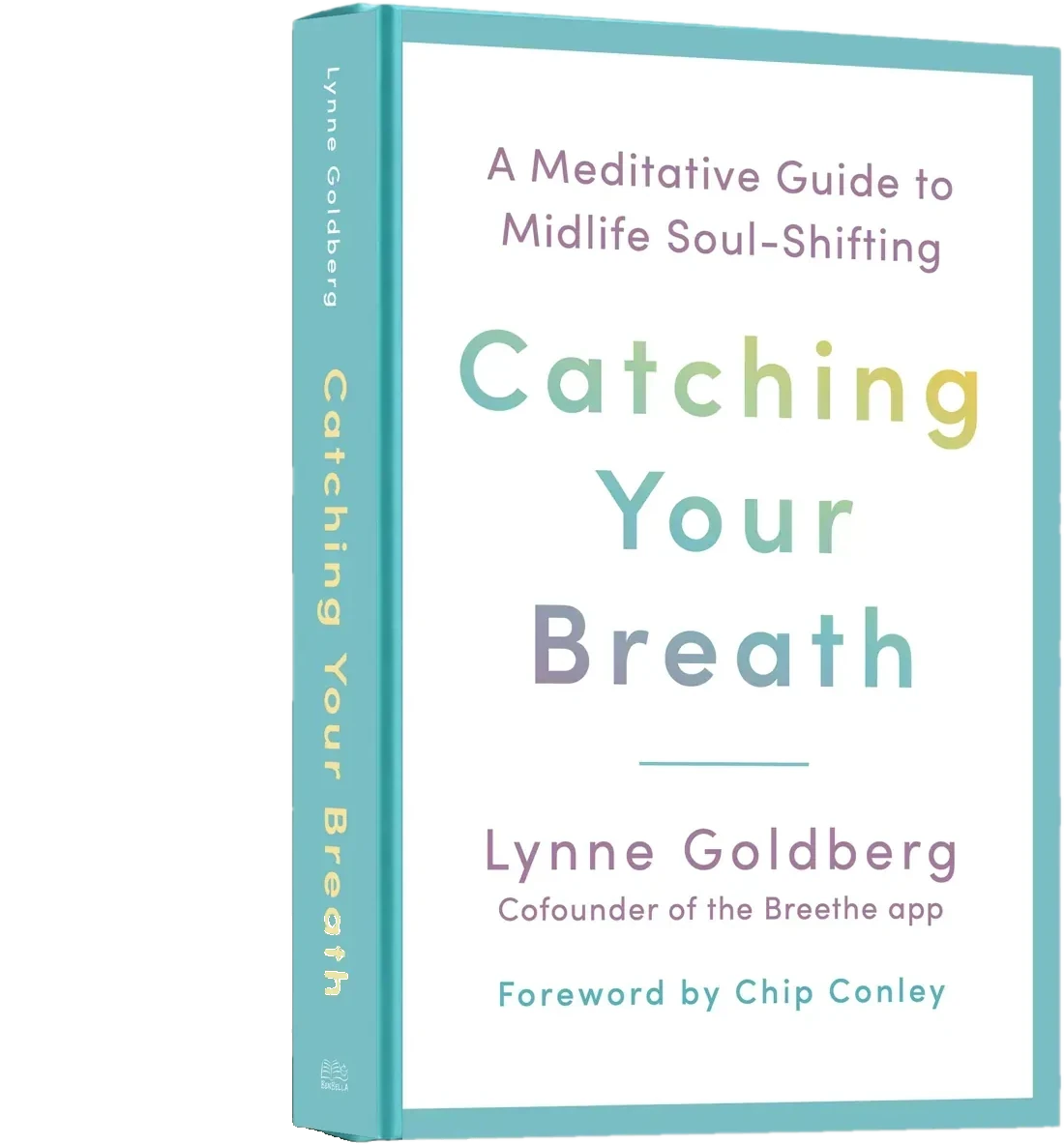
Catching Your Breath
Lynne's new book, on meditation, choicefulness and the changes life brings.