 Lynne Goldberg Meditation

On Unglamorous in the City, Lynne talks with Smitha Rao about loss, divorce and starting over and why meditation isn't about being calm, then leads the show's first real-time breathing exercise.
Highlights
- “Choicefulness is that ability to pause in the middle of everything and decide, hey, I’m going to try it this way this time.”
- “I think people think they have to stop thinking.”
- “Maybe my knight in shining armor ended up being me, and maybe that’s how I can live my best life.”
Transcript
[Smitha welcomes Lynne and asks for an overview of her work.]
Lynne Goldberg: So I started meditating when my life fell apart. And I actually found that meditation was one of the things that was my life jacket in the middle of a storm. And when I had lost twin girls and I had had a marriage breakup and I lost my job and just a series of life storms and found that this was such an important, impactful practice for me, I wanted to share it with as many people as possible. So we launched the Breethe app. And then from there, I realized that this was so, so important. I had wanted to share it with a little bit more depth and a little bit more detail. And so I’m excited because my book is coming out in January.
[Smitha says how sorry she is for everything Lynne went through.]
Lynne Goldberg: Thank you. I think it’s... really life happens to a lot of people and this is I don’t think I’m so unique I think unfortunately or fortunately part of life is that we have a lot of changes a lot of events people die people get sick all kinds of things happen and I think one of the greatest gifts we can give ourselves is learning in the middle of that, how to manage. So I feel blessed because one of those life skills prepares you for everything else that comes your way.
[Smitha says the hard moments put everyday stress in perspective.]
Lynne Goldberg: Yeah, I think what’s interesting is that when stuff happens, which it does, it connects us to everybody else’s humanity. So it’s relatable. You’ve had many unglamorous moments, I’m sure, as have I, as have we all. And when you have those events and you can share it with somebody else and you recognize that we all go through it and there’s something very universal and comforting in knowing that we’re not alone.
[Smitha talks about how social media shows only the glamorous moments, which is why she started the podcast.]
Lynne Goldberg: I love that. One of the things that I find is vulnerability, allowing ourselves to be vulnerable, to be honest, to be authentic. Take off the masks that we all walk around wearing is how we relate to each other and that facade of everything’s perfect. Of course, when you talk to people, you recognize how untrue that actually is. One of the things in my book actually was talking to people and recognizing how many of us all have life events and sharing those stories makes it very heartwarming. You know, that sense of I’m not here alone. I’m here with everybody else and we’re all human and life is hard. And if we have some skills and tools that can help us, you know, we can all manage this and support each other together.
[Smitha asks what Lynne knows now that she wishes she had known in the middle of those events.]
Lynne Goldberg: Absolutely. I think when we’re in the middle of any life events, we tend to react habitually. We have patterns that have served us well, maybe when we were little kids and we started to cry because we skinned our knee, but it doesn’t serve us as adults. And so learning how to deal with things with fresh eyes, observing ourself from a perspective a witnessing perspective. So in other words, stepping out of the, I’m in the middle of this storm and being able to sort of observe it allows you to put a little bit of distance and perspective between you and the event. And that’s very helpful. When you can say with fresh eyes, oh God, I keep doing that. I keep doing the same thing over and over and over again. And it keeps leading me down this path that I don’t wanna go down anymore. Then you get to step out and practice what I call choicefulness. Choicefulness is that ability to pause in the middle of everything and decide, hey, I’m going to try it this way this time.
[Smitha mentions the saying about doing the same thing over and over and expecting different results.]
Lynne Goldberg: Absolutely true and that it’s an interesting definition but it’s also how we live as humans right because if you grew up in a home where you saw your parents fight when they had a conflict then of course you know that’s what you learned that’s the behavior that you think is normal and that’s actually how you interpret love so if you feel that that’s going to resolve a conflict you’re probably going to try that until you know you’re on your second marriage and you go, hey, that’s not working that well for me.
[Smitha asks about Dr. Robert Thurman, Uma Thurman’s father, and his part in the book.]
Lynne Goldberg: So Dr. Robert Thurman is, in his own right, a very, very well-regarded Buddhist practitioner. He actually did the translations for the Tibetan Book of the Dead. And he wrote very eloquently about this idea of transitions. And of course, the idea of the bardo, which is the idea of transitions, between life and death became really relevant while I was writing this book because, of course, all of our lives are transitions. We’re constantly in flux. We’re constantly changing. And so finding the many, many different people that I spoke to that had had life transitions, that had gone through all types of events, including disease, including divorce, children going off to school, losing jobs, all kinds of events that happened to all of us when we hit middle age. If you’ve gotten to a certain age, chances are something has happened to you. And he spoke about his own transition and how that affected him and impacted him and actually changed the trajectory of his life.
[Smitha asks how that transition changed the course of his life.]
Lynne Goldberg: In his case, he called it his spiritual transformation. So he talked about the idea that he went through a plethora of different types of, he called it the spiritual curriculum, actually. And he talked about the different things that he tried because he had gone through this event and how it really impacted him. So I really appreciated how he spoke about that because of course, when I talked about choicefulness, it’s this idea of the agency that we have when something happens to us to allow us to change and to grow from the experience. And, you know, you speak to really well established people that have had years and years and years of exploration and of course, the same message keeps coming up.
[Smitha talks about the challenges that come in your 40s, like aging parents and health.]
Lynne Goldberg: Right. You know, you, you mentioned aging parents and of course, aging parents are one of life’s challenges. It becomes, you become the caretaker for the people that took care of you and it’s, it’s stressful. You didn’t expect to have to do that for your parents and seeing them regress is very difficult. So that’s a challenge and dealing with health issues is a challenge. So even something like high blood pressure, which by the way, meditation actually helps.
[Smitha says she already feels calmer, and that sometimes it helps to disconnect and take a breather.]
Lynne Goldberg: Yeah, I think the idea isn’t about necessarily, because so much of what we do is pushing away feelings, right? We don’t want to feel those uncomfortable feelings. So what we tend to do is try to distract ourselves from the feelings, but sometimes actually being present with them and feeling how they feel in our body and then letting it move through you can change your state very quickly. Instead of fighting, fighting, fighting, fighting, and trying to keep the feeling away, just a couple of breaths to allow it to move really shifts you.
[Smitha says that being in the middle of it can feel so taxing.]
Lynne Goldberg: So that overwhelm that you’re talking about, I think, is that feeling of just being surrounded by. And I think the disconnect, I’m going to use a different word because I’m not, I wouldn’t try to avoid it. I would try to step out of it so that you’re watching it, but you’re watching it from here. You’re not in the middle of the tornado or you’re in the center of the tornado, watching it all around you.
[Smitha says she has always been good at compartmentalizing, and wonders if that helps in the long run.]
Lynne Goldberg: Well, I think there’s times and places for that, right? So you’re right about compartmentalizing. If you’re in the middle of, you know, if you’re being chased by a bear, then you need to escape that bear. That’s a real in the moment event that you need to take care of. Or if you’re in the middle of a hospital setting and you have to deal with things that you’re dealing with, then it’s important to be present for what is happening. What’s important as well is to recognize what’s happening within your body. So if you notice that you’re becoming agitated, then just recognizing that and taking a couple of breaths. Oh, interesting. My heart is pounding. And just allowing yourself to give yourself the body cue to come into your body again. So and that sense of long term yes over time if we continually push away our feelings they’re going to come out they’re just going to come out crooked so you’ll end up screaming at your kid or at your boss or at whoever you know probably not your boss but probably not if you want to get I still have a job of course so but you end up taking it out on you know the person that you’re sitting beside on the subway. Someone looks at you the wrong way and all of a sudden you’re all up in their face. So that isn’t helpful. That isn’t a useful coping technique. What actually is more useful is recognizing that that’s what you’re experiencing and seeing, oh, I seem to be agitated. And then you name it. And something about naming the feeling gives you a little bit of distance from it.
[Smitha says that just taking a deep breath helps, especially in a city where everyone is always running.]
Lynne Goldberg: And it’s really when you take a deep breath in so if you do it with me right now just for like we’ll do it for a couple of seconds just taking the breath in and on your exhalation just see if you can make it a little bit longer than your inhalation so just really allow yourself to breathe all the way and just doing that signals to your body that you’re safe and that everything’s okay. So it really shifts how you feel.
[Smitha says there’s a calm to it.]
[Smitha says she can feel the shift, and asks what people who don’t meditate misunderstand about it most.]
Lynne Goldberg: I think people think they have to stop thinking. And then when their minds are busy, they say, oh, I’m not good at this. And then they give up. But it’s not that at all. It’s actually noticing what you’re thinking. Oh, look, I’m agitated. Oh, look, I’m catastrophizing. Oh, look. And it’s not necessarily even being so busy labeling, but just the simple act of being aware is what you’re practicing. So every time you notice, Oh my God, I keep going back to that text that never came in that I was hoping for. You catch yourself in the thought, and then you come back to the object of your attention. In this case, it was our breath, right? Some people use a mantra. Some people use their breath. Some people use body parts, whatever it happens to be, but it’s not that complicated. And it’s just that act of coming back over and over and over again that trains you to be in the moment, present.
[Smitha says that when you’re agitated, your mind is racing.]
Lynne Goldberg: Well, you’re thinking about something that’s going to happen. Oh my God, I got to get to that. Or I’m expecting that phone call or whatever it is. It’s in the future. Or you’re thinking about what you just left in the past. God, I can’t believe I said that again. Or whatever it might’ve been, right? But you’re not here. And it’s that just being here takes you out of all the other stuff.
[Smitha asks what else Lynne wants people to know about the practice.]
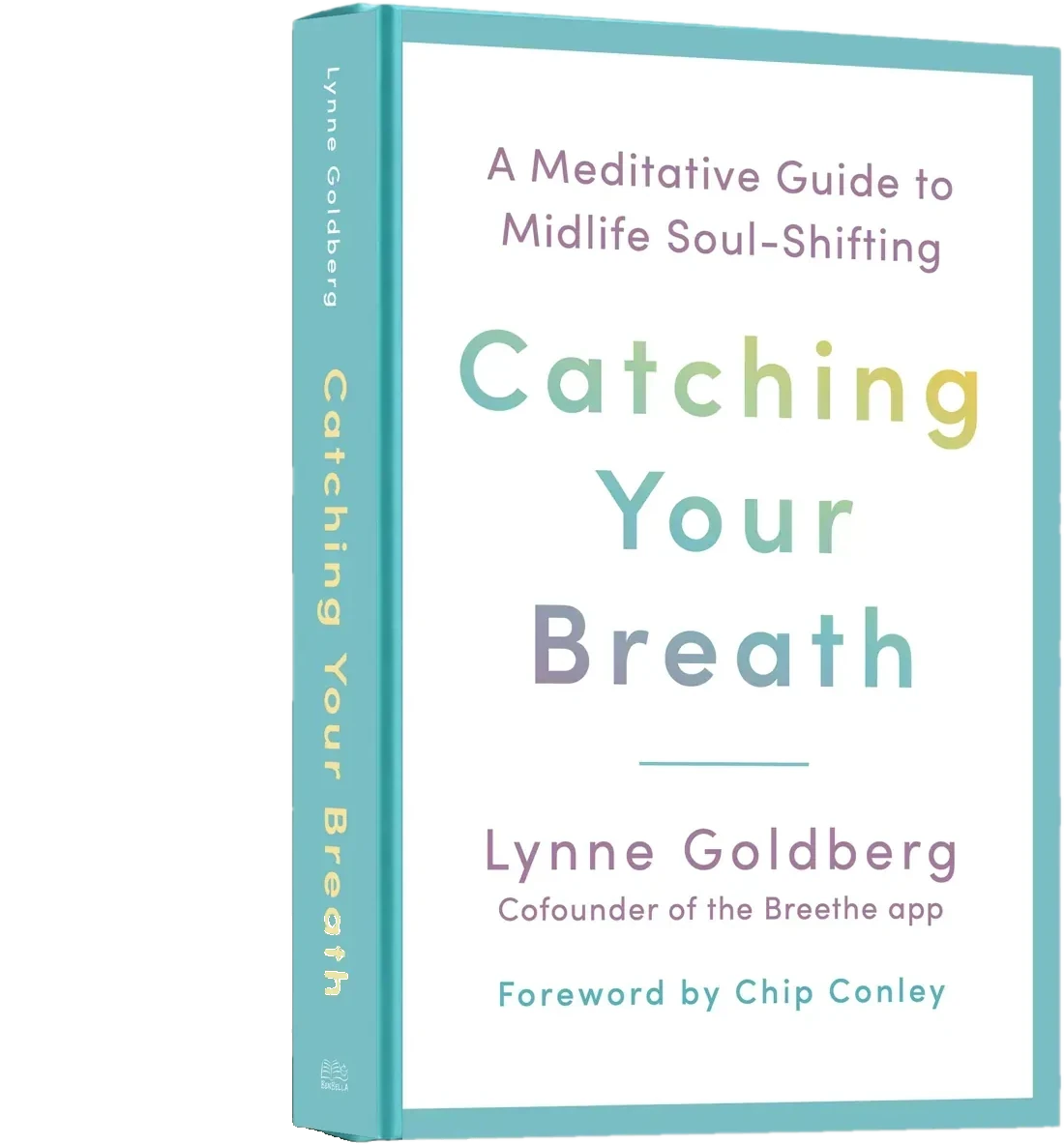
Lynne Goldberg: Yeah, so I think Catching Your Breath, the idea of, and that’s the book, it’s coming out in January, very exciting.
[Smitha asks her to say the name of the book.]
Lynne Goldberg: Catching Your Breath. How appropriate, right? And I think that’s exactly what we need to do much more regularly just pause and allow ourselves to really become choiceful so that we can decide where we’re going next with a lot of intention. So it’s an intentional way of living. And this book is about being really super intentional so that we have agency for the lives we wanna create. Because so often we end up on autopilot just doing the same old, same old over and over and over again. And then we get to the destination that our parents kind of programmed us to be in or whoever, our teachers or society, and we’re not happy. We’re not fulfilled. We don’t feel like we’ve really lived our fullest, best life. Well, this actually shows you how to live your best life. And to me, you don’t know how much time you have, but you do know that while you’re here, you might as well enjoy it.
[Smitha talks about living every day like it’s your last, and mentions the loss of Lynne’s daughters.]
Lynne Goldberg: Twin girls. But, you know, I just recently had another series of events because that’s what life does, right? Life gives us tons of opportunities to... You thought you were good at this? You’re a meditation teacher. Let me see what we can do. And then I was diagnosed with cancer twice and had a 20 year relationship breakup. And so I feel very blessed actually, because every time I I get an opportunity to say, oh yeah, this is precious. This is absolutely, being alive is the opportunity to feel all of the emotions, to feel incredible highs, incredible lows, just all of it. And if you only felt high, it’s like taking a hot shower. If every single day you got into a hot shower, you’d never really appreciate how nice that felt until you get a cold shower, right?
[Smitha says the hard moments are part of everyone’s growth.]
Lynne Goldberg: And I think that sets you up for growth, right? So you can get really stale and really in a rut if you’re just doing the same old, same old over and over and over again. But when you have an event, it sets you up. You get to say, ah, I’ve been doing it this way for a long time. And you know what? There’s some other opportunities that are out there. Let’s see if I can try it another way. And that’s, that’s fun.
[Smitha asks how Lynne first got into this work.]
Lynne Goldberg: So we’re talking close to 30 years now. So 30 years ago, yeah. I was an emergency meditator at the time, which looked like lots of Chardonnay. And I would try to self-medicate. I’d get into bed and I’d wake up at three in the morning. And once I was wide awake, I’d be like, okay, I gotta meditate, I gotta meditate. And I would lie there in bed, hoping that I could get myself back to sleep. And it was actually quite effective. And I was actually able to calm myself down and really self-soothe in a way that was a lot more, it definitely was healthier. So I thought, okay, this stuff works. Let me see if I can do it during the day. And then I started doing it more regularly. And as I became a regular practitioner, I was interested because I became super, you know, interested in learning from as many people as I could. So I started studying and started traveling and then I became a teacher and then I ended up becoming so enamored with this and seeing how much benefit it gave me that I wanted to share it with as many people as possible. So that idea of, you know, learning something that was a skill that I could teach my kids, teach my friends, you know, whoever. One of the ways that we learn to meditate is we try to relax ourselves and that’s really helpful and it helps us go to sleep and it’s awesome. And then we also want to learn how to live our best possible life. And I think that’s, you know, as my practice deepened and I saw how effective it could be for my own journey, I thought, oh, I want to share this too.
[Smitha asks if there will be a book tour.]
Lynne Goldberg: Yeah, we’ve been starting and hopefully by January 2027, I’ll be in a city near you. So we’ll see. It’s been great. You can follow where I am and what’s happening on lynnegoldbergmeditation.com.
[Smitha asks whether one minute of mindfulness can make a difference, and for other tips.]
Lynne Goldberg: Yeah, I find that so often during the course of our day, we need pattern interrupts. So if you have stuff that happens to you regularly, like I get alerts on my computer and every time I hear a little ding, it’s an opportunity for me to pause and take a breath. And it’s almost like it’s my reminder. The other thing that I find really helpful is just noticing red lights. Because first of all, it makes you pay attention on purpose. So you’re really, really being mindful. You’re really being aware of what’s happening in your environment. And then the automatic reaction to that becomes now breathe. So you’re training yourself in real time how to be mindful regularly. So you’re paying attention on purpose, moment to moment, without judgment, boom. Give yourself a bunch of chances to practice during the course of the day.
[Smitha says there are lots of moments in the day for that.]
Lynne Goldberg: Waiting in line at a Starbucks, best time.
[Smitha mentions the frustration of waiting in line.]
Lynne Goldberg: But don’t get frustrated. Use it as, oh, hey, I have a couple minutes. This is, what a gift.
[Smitha says sometimes we just have to slow down.]
Lynne Goldberg: Slow down, but also take time out to really connect because you never know who you’re standing beside in a line. You never know what is going to happen if you’re really there, if you’re present. But if you’re on your phone, you miss half of life. You’re so busy with that that you miss everything that’s around you. You know, if you’re looking down at your phone and there’s a magnificent sunset outside, you don’t see it.
[Smitha describes seeing a rainbow over the city.]
Lynne Goldberg: There you go. That’s pretty cool, actually.
[Smitha asks why simply naming what we feel is so powerful.]
Lynne Goldberg: Because it takes you out of the emotion. So when you’re feeling angry, the tendency is to say, I’m angry, right? And then you associate yourself with the emotion as if it’s your character. But if you name the emotion, now it’s not I’m angry, it’s anger. And that’s very different. There’s a sense of distance between the anger and who you are. You’re not angry. You’re feeling angry. It’s an emotion. It passes.
[Smitha says the more you latch onto a feeling, the more it sticks around.]
Lynne Goldberg: Yeah. And also that sense of identifying with it, you know, when you identify with anything, it becomes much more personal. But when you’re a little bit distanced from it, then it’s not, it’s, it’s not this sense of ego. Let’s put it that way, right? It’s not who you are, it’s an event that’s happening, or an emotion that’s happening.
[Smitha says it loses its power. Lynne asks if she has ever had a sore tooth, and Smitha says she has.]
Lynne Goldberg: No, that’s excruciating. So when you have a sore tooth, it tends to be all you can think of, right? And then all you do is you sit there and you play with your tooth and you touch your tooth and you focus on the pain in your tooth, but you forget that the rest of your body is perfect. And it’s really only the tooth. And if you can remember that we’re not the one little sore tooth, we’re the entire body. Then it’s easier to sort of, it’s the same idea. It’s the idea of being, if you ever have salt and you put it in a small little glass of water, it’s really, really salty. But if you dilute it into a bigger jar of water, not as salty. So same idea.
[Smitha asks what Lynne would say to people living with pain.]
Lynne Goldberg: The exact same thing. I think when, when we, I’m, first of all, pain is, is, is a very interesting idea because there is real actual pain. And when you are going through something that’s excruciating, it can be horrific. And so I’m not at all minimizing that, but they, you know, there’s a lot of studies that have been done on pain and just the minds, the mind and how much we tell ourselves a story about the pain also affects how we feel the pain. So if you say to yourself, this is the worst thing that ever happened to me. And now you’ve created that, you know, you become more anxious about it. So you become more fixated on it and then it becomes a vicious circle. Now you’re completely immersed in it whereas if you can... I mean this is training this is not something that you’re able to do but you can become aware of where the pain is how you can breathe notice what happens when you breathe into the pain and there are steps that you can do that will actually help you not be as immersed in the event.
[Smitha says it’s hard to watch someone you love in pain and feel helpless.]
Lynne Goldberg: But I think you said something really valuable, which is that sense of helplessness as if your job is to, to do something. And I think we all feel that sense of you wanna, you wanna do something. And sometimes the most important thing you can do is just be there, just your presence, just your empathy, just your, your love and recognizing that they are feeling pain can sometimes be the balm that that person needs. Cuz we can’t take away someone else’s pain, but we can, we can love them through it.
[Smitha adds that it helps to acknowledge it.]
Lynne Goldberg: It’s a compassion practice. You know, it’s part of the same area. And basically that idea of, of listening, and not minimizing because you’re exactly right. Our tendency is to say, oh, it’ll pass. It’s not so bad. And then, of course, the person feels unseen.
[Smitha says we can diminish someone’s pain without meaning to.]
Lynne Goldberg: Yeah. We tend to get uncomfortable with big feelings in ourselves and in other people. So learning how to sit with those feelings is really useful.
[Smitha asks whether Lynne imagined Breethe would get this big, and for advice for anyone starting out in wellness.]
Lynne Goldberg: Yeah, when we started a meditation app, meditation wasn’t really a thing. So the idea that, you know, people thought I was nuts. They thought I was, you know, all incense and it was really considered the most, you know, people made fun of me let’s put it that way and then we and now you’re looking at me like how is that possible because it’s so mainstream so I think that if you really believe in something and you feel passionate about it don’t let anything stop you because it’s such a gift to yourself to be able to live out your best possible scenario, but whenever you tend to do something for yourself that also is for other people, how could you not be successful? You know, like the way that you started your podcast, your feeling of unglamorous, that sense of recognizing that we’re all in it together and all of us want to be seen. That’s what you’re basically saying. You’re saying, I see you. And so how could you not make people feel good when you do that? So anything you want to do that comes from your heart, how could you not follow that?
[Smitha says Lynne stuck with it even when people doubted her.]
Lynne Goldberg: Yeah, I mean, we started the app in 2015. So it was not 30 years.
[Smitha jokes about how fast thirty years go by.]
Lynne Goldberg: That is a conversation because I agree with you. It’s like, how did that happen in a flash?
[Smitha says you have to focus on the things that bring you calm.]
Lynne Goldberg: So I don’t know that the intention is calm.
[Smitha asks what the real intention is, if it isn’t calm.]
Lynne Goldberg: You know, there’s this misinformation that’s out there. You asked me before what some of the misinformation is. One is don’t think, don’t have thoughts. But another one is that your intention is to, you know, be all Zen on a mountaintop and all peaceful and calm. And yeah, that’s sometimes a byproduct. But what ends up really being the intention is to really know yourself. And know what your triggers are, know what your automatic patterns are, know what sets you off and what you keep doing over and over and over again, or what’s from your, you know, that childhood pattern that is so done and tired. How can you live in the moment and respond in real time to what’s happening now, not based on the conversation that you heard a thousand times at dinner that you’re now repeating as an adult. And I think that’s where you can end up choosing to live your best life. That’s how you get to do it.
[Smitha says this is a shift in mindset for her.]
Lynne Goldberg: Yeah, thank you. I think we all did. There was many meditation apps that all started and probably because that’s where we were at the time. We probably all were trying to relax because that was what made us feel good. But then you can’t go through life relaxed. Sometimes there’s times where things happen and you need to respond. And you need to do it not from a place of fight-flight, not in that like I’m being attacked by a saber-toothed tiger. You need to be responsive. You need to be in a calm state. But there’s a difference between being like... calm is the wrong word. We’re going to use another word. Maybe the right word for this would be in a responsive state, in a non-reactive state.
[Smitha asks about a pivotal unglamorous moment and how Lynne moved on from it.]
Lynne Goldberg: So my ex-husband of 20 years asked me for a divorce on New Year’s Eve and I had a house full of people and I thought wow I did not see this coming and I think that the best possible thing that could have happened to me was recognizing that, yeah, this wasn’t the life I imagined for myself. I thought I was gonna live happily ever after, but maybe happily ever after doesn’t look like that. Maybe my knight in shining armor ended up being me, and maybe that’s how I can live my best life. And I think that every time we get the opportunity to discover really different facets of ourself and see how we can change and rise and grow. It’s a magic, magic moment. So for me, I thought it was going to go one way. It completely changed everything. And now I feel like I’m the luckiest person in the world.
[Smitha shares that her own life looks different than she expected, and that the relationship with yourself matters most.]
Lynne Goldberg: In my book, I write about dating and, you know, try dating when you’re 59 and you haven’t been on a date in however many years. And I have to say there are so many funny parts to that because any time you get to rediscover those parts of you that maybe have been hidden for a while, which is dating, which is navigating being single, which is getting, you know, ending up in the East for, I don’t know, for a period of time. How fabulous. The people that you get to meet, the experiences that you get to have, you know?
[Smitha talks about her solo travels.]
Lynne Goldberg: I agree. I agree. And the people that you meet that you wouldn’t have the opportunity to because you’d be in your bubble, but somehow looking up and getting to talk to people who you might not otherwise talk to. Fabulous. What an experience.
[Smitha says it helps to get comfortable doing things on your own.]
Lynne Goldberg: Yeah, I agree with you.
[Smitha asks where people can find Lynne.]
Lynne Goldberg: So my website is Lynne Goldberg. You’re going to have show notes that they can find it in.
[Smitha says she can put a graphic at the bottom of the screen.]
Lynne Goldberg: So lynnegoldbergmeditation.com. And our book is Catching Your Breath. And that’ll be out in January. You can pre-order it now.
The book
Catching Your Breath
Lynne's new book, on meditation, choicefulness and the changes life brings.