 Lynne Goldberg Meditation

On a Milken Institute panel about the global mental health crisis, Lynne talks about stress, what mindfulness is, how meditation trains attention, and using technology mindfully.
Highlights
- “So mindfulness is really nothing more than paying attention on purpose, moment to moment, without judgment.”
- “So the more you come into the present moment and train yourself, it's an attention muscle, and it gets stronger the more you practice.”
- “So really, it's vital that you engage with whatever tool you're using mindfully, and then you can use it.”
Transcript
[The moderator, Latisse Briggs of the Milken Institute Center for Strategic Philanthropy, opens the panel on the global mental health crisis and asks each panelist to introduce themselves.]
Lynne Goldberg: I became interested in meditation when my life fell apart. I had lost twin girls. My mother had been diagnosed with stage four colon cancer. And then I lost my job, and my marriage fell apart. And meditation was the tool that helped me put my life back together. And when I saw how well it worked for me, I was very passionate about becoming experienced at it. I trained, I became a teacher, and then started teaching other people so that they could have the same advantages that I was able to have.
[The moderator asks each panelist, when they think about the challenges of mental health and mental illness, what keeps them up at night.]
Lynne Goldberg: So for me, it's stress. When we look at how many people are feeling stressed, it's shocking. I think 44% of the population says that they're more stressed today than they were five years ago. And of course, what stress does to our bodies and our minds is awful.
Lynne Goldberg: You know, we have that fight-flight reaction that we all learned in high school, where we feel like we're being attacked by a saber-toothed tiger. And we're releasing cortisol and adrenaline into our bodies regularly throughout the day; supposedly we have about 8 to 10 stress reactions a day. And each time we're doing that repeatedly, that chronic stress is increasing our heart rate, our blood pressure. We're not digesting food properly, because we're going to be running away from that saber-toothed tiger.
Lynne Goldberg: So luckily, the antidote for that is actually meditation. When you meditate, you're releasing oxytocin, which is the love hormone, into your body. You're releasing serotonin, which is the feel-good hormone. So it's something that's transportable and helps.
[The moderator turns to meditation and mindfulness and asks Lynne what exactly mindfulness is and how we use it.]
Lynne Goldberg: So mindfulness is really nothing more than paying attention on purpose, moment to moment, without judgment. So what do I mean by that? If you've ever driven to work and been on autopilot the whole time, and you get there and you're like, oh my God, where have I been for the past 15 minutes? Because your mind was either still at home with your family or already at the office having a conversation with your boss, but definitely not mind and body together at the same time.
Lynne Goldberg: What we train people to do is to bring your mind to an object of your attention. And it could be anything from your breath to parts of your body to whatever it is. You notice where your mind is, you come back to the object of your attention. And so, for most of us who have 40,000 to 60,000 thoughts a day, and most of them are the same ones that we had the day before, we keep going over and over and over with those same thoughts, or we're worried about things that might never happen or things that already did happen. Being present is really something that we can train ourselves to do. So the more you come into the present moment and train yourself, it's an attention muscle, and it gets stronger the more you practice.
Lynne Goldberg: The other thing that happens with meditation is that it physically changes your brain. So remember I talked about that fight-flight reaction before? The amygdala, which is the part of our brain that is responsible for that fight-flight reaction, actually shrinks with meditation.
[The moderator asks how mindfulness can be used as a tool for someone with a mental health disorder.]
Lynne Goldberg: What you practice grows stronger. So the more you practice being present, the better you get at it. So you'll notice that your mind is wandering, and then you have trained yourself to come back to the present. So what we find is that one of the things about training your mind is that if you are truly aware of where your mind is, then you can actually start to become very adept at noticing your self-talk.
Lynne Goldberg: So what we do is we teach people to set your alarm first thing in the morning, and the first thing that happens is your alarm goes off and you start with a meditation. And then you have reminders during the course of your day that can help you also be more present. And then we have situational type meditations. So whether you're standing in line or commuting, you have another opportunity to practice. And this becomes a tool. This becomes a way to remind you that this is how you're living your life.
[An audience member asks the panel about the impact of social media and screens on our minds, and the panelists discuss how digital tools can also be part of the solution.]
Lynne Goldberg: To that point, we call technology neutral. So the idea is that a knife in the hands of a surgeon is a healing tool, and in the hands of a murderer, it's a murder weapon. So really, it's vital that you engage with whatever tool you're using mindfully, and then you can use it.
The book
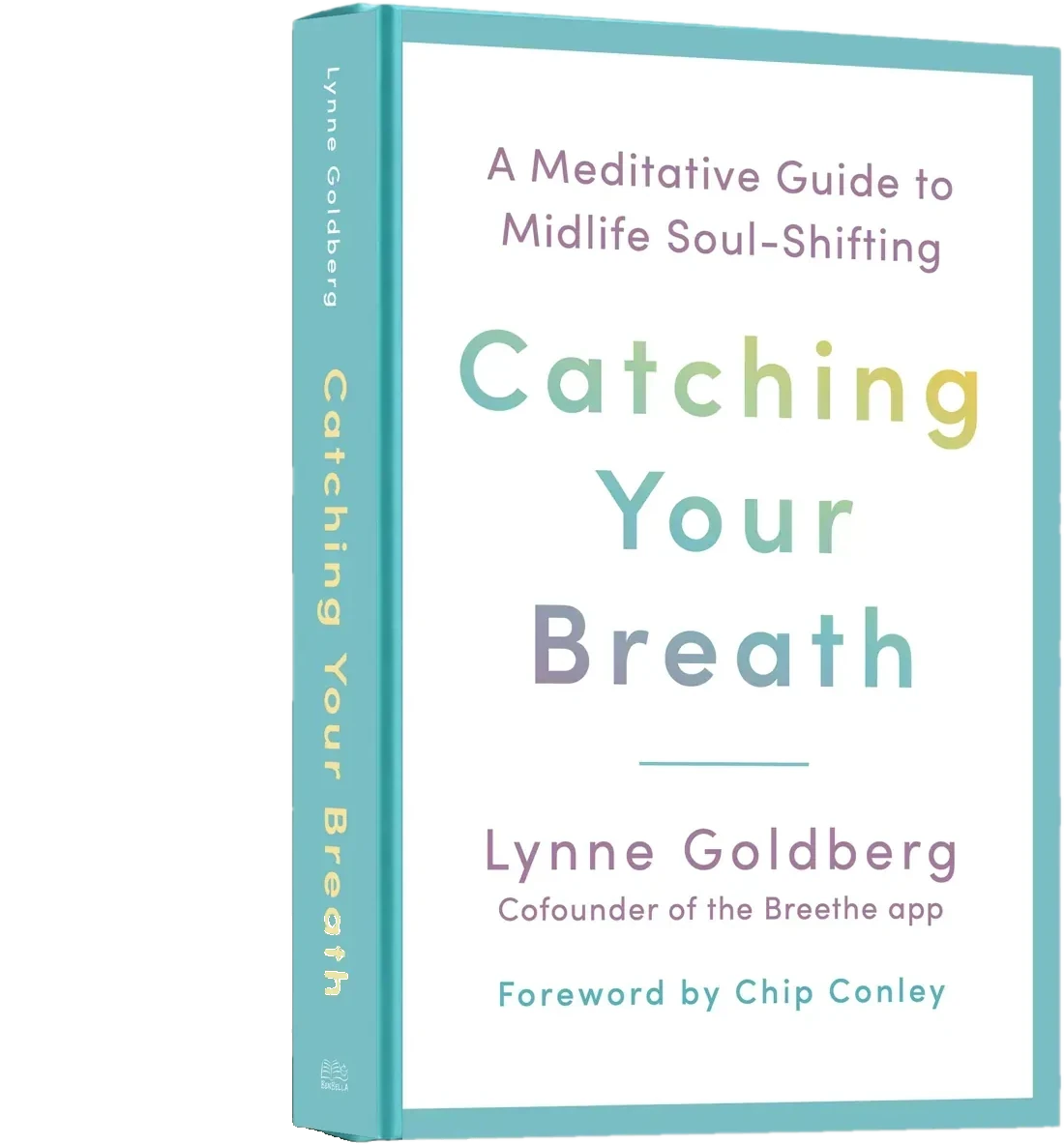
Catching Your Breath
Lynne's new book, on meditation, choicefulness and the changes life brings.